
MSS SP-119-2025 工厂制造锻造钟形端承插焊接管件标准实践

VIP专享

MSS SPxxx-202x
Standard Practice developed and approved by
the Manufacturers Standardization Society of
the Valve and Fittings Industry, Inc.
The Technical Voice of the Industry ®
441 North Lee Street
Alexandria, Virginia 22314
www.msshq.org
Manufacturers
Standardization Society
OF THE VALVE AND FITTINGS INDUSTRY
PROVIDING INDUSTRY STANDARDS SINCE 1924
MSS SP-119
2025 Edition
Factory-Made Wrought
Belled-End Pipe Fittings
for Socket-Welding

MSS SP-119-2025
i © MSS 2025 – All rights reserved
This MSS Standard Practice was developed under the consensus of the MSS Technical Committee 113, Wrought Welding
Fittings, and the MSS Coordinating Committee. The content of this Standard Practice is the resulting efforts of
knowledgeable and experienced industry volunteers to provide an effective, clear, and non-exclusive standard that will
benefit the industry as a whole. This MSS Standard Practice describes minimal requirements and is intended as a basis
for common practice by the manufacturer, the user, and the industry at large. It is the responsibility of the user of this
Standard Practice to establish appropriate safety and health practices and determine the applicability of regulatory
requirements prior to use. The existence of an MSS Standard Practice does not in itself preclude the manufacture, sale,
or use of products not conforming to the Standard Practice. Mandatory conformance to this Standard Practice is
established only by reference in other documents such as a code, specification, sales contract, or public law, as
applicable. MSS has no power, nor does it undertake, to enforce or certify compliance with this document. Any
certification or other statement of compliance with the requirements of this Standard Practice shall not be attributable
to MSS and is solely the responsibility of the certifier or maker of the statement.
“Unless indicated otherwise within this MSS Standard Practice, other standards documents referenced to
herein are identified by the date of issue that was applicable to this Standard Practice at the date of
approval of this MSS Standard Practice (see Annex A). This Standard Practice shall remain silent on the
validity of those other standards of prior or subsequent dates of issue even though applicable provisions
may not have changed.”
By publication of this Standard Practice, no position is taken with respect to the validity of any potential claim(s) or
of any patent rights in connection therewith. MSS shall not be held responsible for identifying any patent rights.
Users are expressly advised that determination of patent rights and the risk of infringement of such rights are
entirely their responsibility.
For all MSS Standard Practices, the term “shall” means “must” and “shall not” means “must not”.
In this Standard Practice, all text, notes, annexes, tables, figures, and references are construed to be “normative”
and essential to understand the standard’s message. All appendices and footnotes, or any other information
denoted as “supplemental”, that may be included within this Standard Practice, DO NOT involve mandatory or
normative requirements.
U.S. customary units in this Standard Practice are the standard; the SI (metric) units are based on common equivalencies
and are for reference only. Combining or converting values between the system of measurement utilized and “reference”
values may result in non-conformance with this Standard Practice.
This Standard Practice has been substantively revised from the previous 2010 edition. It is suggested that if
the user is interested in knowing what changes have been made, that direct page by page comparison should
be made of this document and that of the previous edition.
Non-toleranced dimensions in this Standard Practice are nominal unless otherwise specified.
Excerpts of this Standard Practice may be quoted with written permission. Credit lines should read ‘Extracted from MSS
SP-119-2024 with permission of the publisher, Manufacturers Standardization Society of the Valve and Fittings
Industry’. Reproduction and/or electronic transmission or dissemination is prohibited under copyright convention
unless written permission is granted by the Manufacturers Standardization Society of the Valve and Fittings Industry
Inc. All rights reserved.
Originally Approved: November 1996
Originally Published: January 1997
Current Edition Approved: August 2024
Current Edition Published: January 2025
MSS is a registered trademark of the Manufacturers Standardization Society of the Valve and Fittings Industry, Inc.

MSS SP-119-2025
© MSS 2025 – All rights reserved ii
Foreword
ASME B16.9 is the American Standard for steel butt-welding fittings and although not so stated, it implied that its
scope dealt primarily with standard (Schedule 40) wall and heavier as it was developed for carbon steel and those
grades of alloy steel piping that are selected for pressure and temperature considerations. In 1949 ASME approved
standard ASME B36.19 for Stainless Steel Pipe in which Schedule 10S was established. Schedule 5S pipe was
recognized in the 1952 publication of ASME B36.19. The companion fittings for Schedule 10S pipe used ASME B16.9
shapes and proportions and were standardized by MSS SP-43, which was first published in 1950. In anticipation, the
original 1950 edition of MSS SP-43 also standardized Schedule 5S fittings.
Since 1950 the use of lighter than standard wall stainless steel piping in new construction has become predominant.
The reasons for this evolution include the rapid expansion of the process industries in the fields of chemicals, plastics,
textiles, paper, etc.
Coincident with the greater utilization of light wall pipe and of more capable metal forming machinery, the need to
reduce pipe assembly fabrication times brought about by world market competition led to the development of belled-
end socket-welding fittings. As with the development of MSS SP-43, the shapes and proportions for ASME B16.9 were
reused for the belled-end fitting bodies to the maximum extent possible.
In 1992 first work on belled-end fittings for this Standard Practice included defining socket proportions, socket to
fitting body transition geometry, fitting thickness, and determining the ability of U.S. industry to support
manufacturing. Some of this work only standardized service proven relationships used in belled-end fittings made
for the pulp and paper industry without standards for over 20 years. In 1994 the U.S. Navy funded burst and fatigue
testing prototype fittings in the first of a two-phase program. The second phase was for an increased thickness fitting
and was never done. In 1995 mid-way through testing, the Navy directed that these belled-end fittings be used on
ship systems in new construction followed shortly thereafter by direction to use them on the repair of ship systems.
The quality and configuration control of these fittings was done by an interim document, the requirements of which,
with some improvements, are contained herein.
In keeping with trends wherein military procurement activities have been using more commercial material
standards and because of recognized fabrication economies related to the use of these fittings, the U.S. Navy
sponsored the writing of the 1996 edition of this Standard Practice in cooperation with fitting manufacturers.
This Standard Practice established dimensional uniformity for light wall belled-end socket-welding fitting designs
qualified by burst and fatigue testing for Military Service and qualified by burst testing for Commercial Code Practice.
The most significant changes in the 2003 revision included the following: 1) A new definition for allowable pressure
ratings for MP fittings (Section 6), which adopts the ASME B16.9 format rating the fitting the same as the connecting
pipe of the same schedule; 2) The addition of titanium and aluminum fitting materials; and 3) The addition of the
Supplementary Requirements (Section 18, now 17), which supports Navy special requirements.
The most significant changes in the 2010 revision included the following: 1) The extension of the SCOPE to include
heavier wall fittings; 2) The relocation of the CR fitting requirements from the body of the Standard Practice to that
of a Supplementary Requirement; 3) The addition of all the combinations of reducing fittings included in ASME B16.9;
and, 4) The addition of a reference line on the socket end to enable inspectors to measure the installation weld length
– as a Supplementary Requirement. The title of the 2010 revised Standard Practice was also amended.
The most significant change in this 2024 revision is the addition of 0.25 in. to the reducing outlet branch length in
reducing branch tees with run sizes of 2, 21⁄2 and 3, which tees are shown in Table 9. This change will enhance
fabrication quality by removing the branch weld from the forming area. The remaining revisions to this Standard
Practice mostly involve maintenance, format updating and editorial or clarifying corrections, rather than substantive
changes, and do not affect form, fit, function, materials, or inventory.

(MSS SP-119-2025 工厂制造锻造钟形端承插焊接管件标准实践,(共38页),pdf,1.34MB,https://www.bjxwk.com/doc/255012/)
声明:本文档系会员上传,若文档所含内容侵犯了您的版权或隐私,请立即通知,我们立即给予侵权申诉删除!
相关推荐
-
SAE AMS-QQ-A-367E-2018VIP免费

 2024-09-07 110
 -
SAE AMS 4037R-2020 航空材料规范VIP免费
 2024-09-07 331
 -
SAE AMS 4050K-2021 航空航天材料规范VIP专免
 2024-09-07 529
 -
SAE AMS 5520H-2021 耐腐蚀、耐热钢规范VIP专免
 2024-09-07 266
 -
SAE AMS 5643W-2021 耐腐蚀钢规范VIP专免
 2024-09-07 386
 -
SAE AMS 5645T-2022 耐腐蚀耐热钢棒材、线材、锻件、机械用管材、环件及锻坯18Cr-10Ni-0.40Ti(321型)固溶热处理VIP专享
 2024-09-07 274
 -
SAE AMS 5662P-2022VIP专享
 2024-09-07 203
 -
SAE AMS 5663P-2022VIP专享
 2024-09-07 155
 -
SAE AMS-STD-2154E-2021 锻制金属的超声检测工艺规范VIP专享
 2024-09-07 461
 -
SAE AMS 2750H-2024 高温测定VIP专享
 2025-03-14 640
作者:标准小能手
分类:国外协会
价格:30星币
属性:38 页
大小:1.34MB
格式:PDF
时间:2026-10-13
相关内容
-
SAE AMS 5696F-2025 耐腐蚀耐热钢焊丝19Cr-12.5Ni-2.5Mo高铁素体等级 (UNS S31683)
分类:国外协会
时间:2026-08-30
标签:腐蚀
格式:PDF
价格:35 星币
-
SAE AMS 5711G-2025 镍合金 耐腐蚀和耐热钢 棒 锻件和环65Ni - 15.8Cr - 15.2Mo - 0.30Al - 0.05La溶液热处理 (UNS N06635)
分类:国外协会
时间:2026-08-30
标签:腐蚀
格式:PDF
价格:35 星币
-
SAE AMS 3217-7C-2026 高强度氟硅树脂(FVMQ)试验板
分类:国外协会
时间:2026-08-30
标签:高强度
格式:PDF
价格:35 星币
-
SAE AMS 5342G-2026 钢 耐腐蚀 投资铸件 16Cr - 4.1Ni - 0.28Cb(Nb) - 3.2Cu 均质化 溶液和沉淀热处理(H1100) 130 Ksi(896 Mpa)拉伸强度 (UNS J91280 and UNS J92200)
分类:国外协会
时间:2026-08-30
标签:腐蚀
格式:PDF
价格:35 星币
-
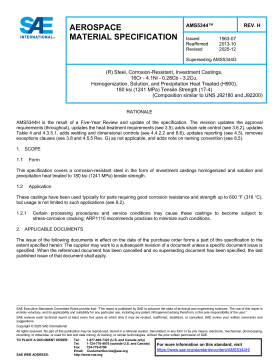
SAE AMS 5344H-2026 钢 耐腐蚀 熔模铸件 16Cr-4.1Ni-0.28Cb-3.2Cu 均匀化 固溶和沉淀热处理(H900) 180 ksi(1241兆帕)拉伸强度 (UNS J92180 and J92200)
分类:国外协会
时间:2026-08-30
标签:腐蚀
格式:PDF
价格:35 星币


