
MSS SP-44-2026 钢制管道法兰 Steel Pipeline Flanges

VIP专免

MSS SP-44-2026
i © MSS 2026 – All rights reserved
Standard Practice developed and approved by
the Manufacturers Standardization Society of
the Valve and Fittings Industry, Inc.
The Technical Voice of the Industry ®
441 North Lee Street
Alexandria, Virginia 22314
www.msshq.org
Manufacturers
Standardization Society
OF THE VALVE AND FITTINGS INDUSTRY
PROVIDING INDUSTRY STANDARDS SINCE 1924
MSS SP-44
2026 Edition
Steel Pipeline Flanges
Copyright Manufacturers Standardization Society of the Valve and Fittings Industry.
Provided by Accuris under license with MSS
Licensee=China National Offshore Oil Co/5965930001, User=shan, shichao
Not for Resale, 03/07/2026 08:38:27 UTC
No reproduction or networking permitted without license from Accuris
--`,``,,,,,,,,``,`,,`,,````,,-``,,`,,,,-``,,`,,,,---

MSS SP-44-2026
i © MSS 2026 – All rights reserved
This MSS Standard Practice was developed under the consensus of the MSS Technical Committee 110, Steel Flanges &
Flanged Fittings, and the MSS Coordinating Committee. In addition, this Standard Practice was approved by an
ANSI/MSS Consensus Committee and by ANSI as an American National Standard. The content of this Standard Practice
is the resulting efforts of knowledgeable and experienced industry volunteers to provide an effective, clear, and non-
exclusive standard that will benefit the industry as a whole. This MSS Standard Practice describes minimal
requirements and is intended as a basis for common practice by the manufacturer, the user, and the industry at large.
It is the responsibility of the user of this Standard Practice to establish appropriate safety and health practices and
determine the applicability of regulatory requirements prior to use. The existence of an MSS Standard Practice does
not in itself preclude the manufacture, sale, or use of products not conforming to the Standard Practice. Mandatory
conformance to this Standard Practice is established only by reference in other documents such as a code, specification,
sales contract, or public law, as applicable. MSS has no power, nor does it undertake, to enforce or certify compliance
with this document. Any certification or other statement of compliance with the requirements of this Standard Practice
shall not be attributable to MSS and is solely the responsibility of the certifier or maker of the statement.
“Unless indicated otherwise within this MSS Standard Practice, other standards documents referenced to herein are
identified by the date of issue that was applicable to this Standard Practice at the date of approval of this MSS Standard
Practice (see Annex F). This Standard Practice shall remain silent on the validity of those other standards of prior or
subsequent dates of issue even though applicable provisions may not have changed.”
By publication of this Standard Practice, no position is taken with respect to the validity of any potential claim(s) or of any
patent rights in connection therewith. MSS shall not be held responsible for identifying any patent rights. Users are expressly
advised that determination of patent rights and the risk of infringement of such rights are entirely their responsibility.
For all MSS Standard Practices, the term “shall” means “must” and “shall not” means “must not”.
In this Standard Practice, all text, notes, annexes, tables, figures, and references are construed to be “normative” and essential
to understand the standard’s message. All appendices and footnotes, or any other information denoted as “supplemental”,
that may be included within this Standard Practice, DO NOT involve mandatory or normative requirements.
The SI (Metric) units and U.S. Customary units included within this Standard Practice are regarded separately
as the standard; each should be used independently of the other and may not be technically equivalent.
Combining or converting values between the two systems of measurement may result in non-conformance with
this Standard Practice.
This Standard Practice has been substantively revised from the previous 2019 edition. It is suggested that if
the user is interested in knowing what changes have been made, that direct page by page comparison should
be made of this document and that of the previous edition.
Non-toleranced dimensions in this Standard Practice are nominal unless otherwise specified.
Excerpts of this Standard Practice may be quoted with written permission. Credit lines should read ‘Extracted from ANSI/MSS
SP-44-2026 with permission of the publisher, Manufacturers Standardization Society of the Valve and Fittings Industry’.
Reproduction and/or electronic transmission or dissemination is prohibited under copyright convention unless written
permission is granted by the Manufacturers Standardization Society of the Valve and Fittings Industry Inc. All rights reserved.
Originally Published by MSS: July 1952
Originally Approved by ANSI: December 2014
Original ANSI/MSS Edition Published: January 2015
Current Edition Approved by MSS: September 2025
Current ANSI/MSS Edition Approved by ANSI: February 2026
Current ANSI/MSS Edition Published: February 2026
MSS is a registered trademark of the Manufacturers Standardization Society of the Valve and Fittings Industry, Inc.
Copyright Manufacturers Standardization Society of the Valve and Fittings Industry.
Provided by Accuris under license with MSS
Licensee=China National Offshore Oil Co/5965930001, User=shan, shichao
Not for Resale, 03/07/2026 08:38:27 UTC
No reproduction or networking permitted without license from Accuris
--`,``,,,,,,,,``,`,,`,,````,,-``,,`,,,,-``,,`,,,,---

MSS SP-44-2026
© MSS 2026 – All rights reserved ii
Foreword
The Manufacturers Standardization Society originally developed this Standard Practice in response to the continued
requests for steel pipe flanges for pipeline use, particularly in sizes larger than those covered by ANSI Standard B16.5
on Steel Pipe Flanges and Flanged Fittings. The line pipe is uniquely characterized by high-strength, cold worked, thin-
wall of the carbon steel grade, which necessitates special considerations for the welding end of the flanges.
The size and pressure class range were originally NPS 26 through NPS 36 in pressure classes customarily designated
in ANSI Standard B16.5 as 300, 400, 600, and 900 lb.
The 1970 edition deleted the slip-on flanges for lack of demand, and then added a 150 lb Class and coverage for NPS 12
through NPS 24. Additional coverage was also necessitated by the advent of the use of line pipe of grades having
minimum specified yield strength higher than the 52 000 psi maximum contemplated at the time of initial development,
and therefore still thinner walls.
In some instances, this advent widened the differential between the tensile properties of the flange steel versus that of
the mating pipe steel. This, in turn necessitated greater flexibility in the selection of hub dimensions, so that various
combinations of material-strength and flange-dimensions could be utilized to supply the flanges. Section 5 on Flange
Design was introduced at this point and is one of the key features of this Standard Practice.
The 1972 edition included the coverage of blind flanges in all pressure classes and clarification of text requirements
for better understanding and usage under the more diverse conditions.
The 1975 edition expanded the size range above NPS 36. The drilling templates for the Class 150 flanges of the NPS 38
and larger sizes continued the previous philosophy of adopting the drilling template of the Class 125 of ANSI/ASME
Standard B16.1. However, the drilling templates of the Class 300 flanges of the NPS 38 and larger sizes did not continue
the adoption of the Class 250 of ANSI/ASME Standard B16.1 drilling templates, nor did the NPS 38 and larger sizes of
Classes 400, 600, and 900 continue the extrapolation of ANSI/ASME B16.5 drilling templates; instead, these drilling
templates were necessarily designed more compactly because of the increased loads. While these flanges are
designated by the customary ANSI Standard Class 150, 300, 400, 600, and 900, their use is almost entirely confined to
cross country transmission pipelines at atmospheric temperatures. The flanges have been designed primarily for use
at their cold ratings which conform to the ANSI/ASME Standard B16.5 ratings of 100 °F, and are intended primarily for
attachment to relatively thin-wall, high-strength cold worked pipe, and high-strength butt-welding fittings in pipeline
service at temperatures of 450 °F and lower. However, flanges forged of other materials are capable of pressure
temperature ratings as specified in Section 2.1.
The 1981 edition brought the document into closer editorial alignment with ANSI/ASME B16.5. However, out of
recognition of the successful experience of the pipeline industry, room temperature ratings were extended to 250 °F.
Users are cautioned that when these flanges are bolted to valves and used at temperatures between 100 °F and 450 °F,
the rating of the valve may not be as high as the flange.
The 1990 revision of this Standard Practice was required to update the referenced standards list and delete the SI
(metric) equivalents.
The 1991 revision of this Standard Practice was required to add blind flange machining guidance, flat face requirements
and precautionary notes as well as updating of the referenced standards.
The 1996 revision adds a table with permissible imperfections in flange facing finish and clarifies Annex A design
criteria. There were several errata, or corrections made to references to other standards. Dimensional tolerances have
been changed where necessary to conform to ASME B16.5 and ASME B16.47.
The 2006 revision was required to add SI (metric) equivalent units, notch toughness requirement, new bolting
materials and update of reference standards list.
The 2010 revision recognized the existence of ASME B16.47 Series A flanges, which adopted MSS SP -44
dimensions but does not cover the MSS SP-44 high strength materials used in the pipeline industry to match API
line pipe of equivalent grades.
In 2014, this Standard Practice (2010 Edition) was ANSI-approved as an American National Standard. This process
involved an ANSI/MSS Consensus Committee that was composed of a diverse volunteer group of industry
stakeholders with a material interest in the topic of this Standard Practice. This American National Standard edition,
Copyright Manufacturers Standardization Society of the Valve and Fittings Industry.
Provided by Accuris under license with MSS
Licensee=China National Offshore Oil Co/5965930001, User=shan, shichao
Not for Resale, 03/07/2026 08:38:27 UTC
No reproduction or networking permitted without license from Accuris
--`,``,,,,,,,,``,`,,`,,````,,-``,,`,,,,-``,,`,,,,---

摘要:
展开>>
收起<<
本页面详细介绍《MSS SP-44-2026 钢制管道法兰》标准规范,涵盖该标准的最新修订内容、适用范围及技术要点。MSS SP-44-2026 是美国阀门及配件工业制造商标准化协会(MSS)发布的最新版钢制管道法兰标准,专为高压、高温及大直径管线系统设计,适用于石油、天然气、化工及能源输送领域。该标准对法兰的材料等级(如A105、A694等)、压力-温度额定值、尺寸公差、螺栓连接及密封面类型(包括RTJ、凸台面等)作出明确规定,并引入了2026年版本中对制造工艺、无损检测及标记要求的更新。本描
声明:本文档系会员上传,若文档所含内容侵犯了您的版权或隐私,请立即通知,我们立即给予侵权申诉删除!
相关推荐
-
ISO TR 25901-1-2016 焊接及相关工艺-词汇第1部分:通用术语VIP免费

 2024-09-13 166
 -
ISO IEC Guide 98-3-2008 Suppl.2-2011 测量不确定度第3部分:测量不确定度表达指南 (GUM:1995) 补充 2:扩展到任意数量的输出量VIP免费
 2024-09-15 155
 -
ISO 4413-2010 液压流体动力-系统及其元件的一般规则和安全要求VIP免费
 2025-02-07 147
 -
ISO 965-2-2024 通用公制螺纹 公差 第2部分:内螺纹和外螺纹尺寸极限VIP免费
 2025-03-20 283
 -
ISO 6583-2024 甲醇作为船用燃料 一般要求和规范VIP免费
 2025-04-02 236
 -
ISO 23908-2024 锐器伤害防护 用于血液测试、监测、取样和医疗物质给药的一次性针头、导管引入器和针头的锐器防护机构 要求和试验方法VIP免费
 2025-04-16 152
 -
ISO 14119-2024 机械安全——与防护装置相关的联锁装置——设计和选择原则VIP免费
 2025-04-21 170
 -
ISO 6028-2023 医疗机构管理 流行病应对 自我症状检查应用程序的功能要求VIP免费
 2025-05-18 197
 -
ISO 12233-2024 数字照相机——分辨率和空间频率响应VIP专免
 2025-06-22 200
 -
ISO 14001-2026 环境管理体系 要求和使用指南 高清英文版VIP免费
 2026-04-20 999+
作者:标准小能手
分类:国外协会
价格:24星币
属性:70 页
大小:1.63MB
格式:PDF
时间:2026-04-30
相关内容
-
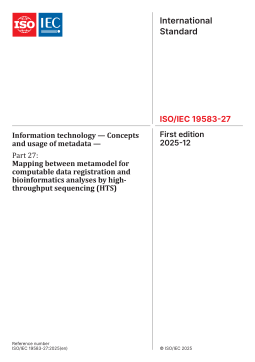
ISO IEC 19583-27-2025 信息技术 元数据概念与使用 第27部分:可计算数据注册元模型与高通量测序生物信息学分析之间的映射
分类:国际标准
时间:2026-09-10
标签:ISO
格式:PDF
价格:26 星币
-
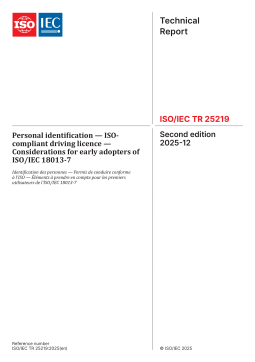
ISO IEC TR 25219-2025 个人识别 — ISO合规驾驶执照 — ISOIEC 18013-7早期采用者需考虑的事项
分类:国际标准
时间:2026-09-10
标签:ISO
格式:PDF
价格:26 星币
-
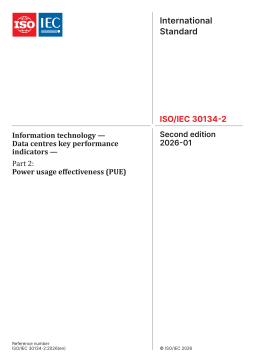
ISO IEC 30134-2-2026 信息技术 — 数据中心关键性能指标 — 第2部分:电能使用效率(PUE)
分类:国际标准
时间:2026-09-10
标签:ISO
格式:PDF
价格:26 星币
-

ISO IEC 30108-1-2026 生物测定 身份属性验证服务 第1部分IAVS服务
分类:国际标准
时间:2026-09-10
标签:ISO
格式:PDF
价格:26 星币
-
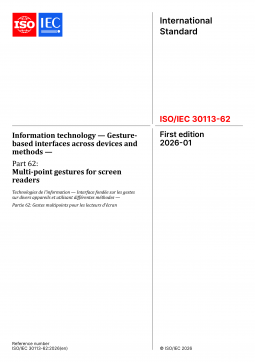
ISO IEC 30113-62-2026 信息技术 跨设备和方法的基于手势的界面 第62部分屏幕阅读器的多点手势
分类:国际标准
时间:2026-09-10
标签:ISO
格式:PDF
价格:26 星币


